01Problem
What was broken
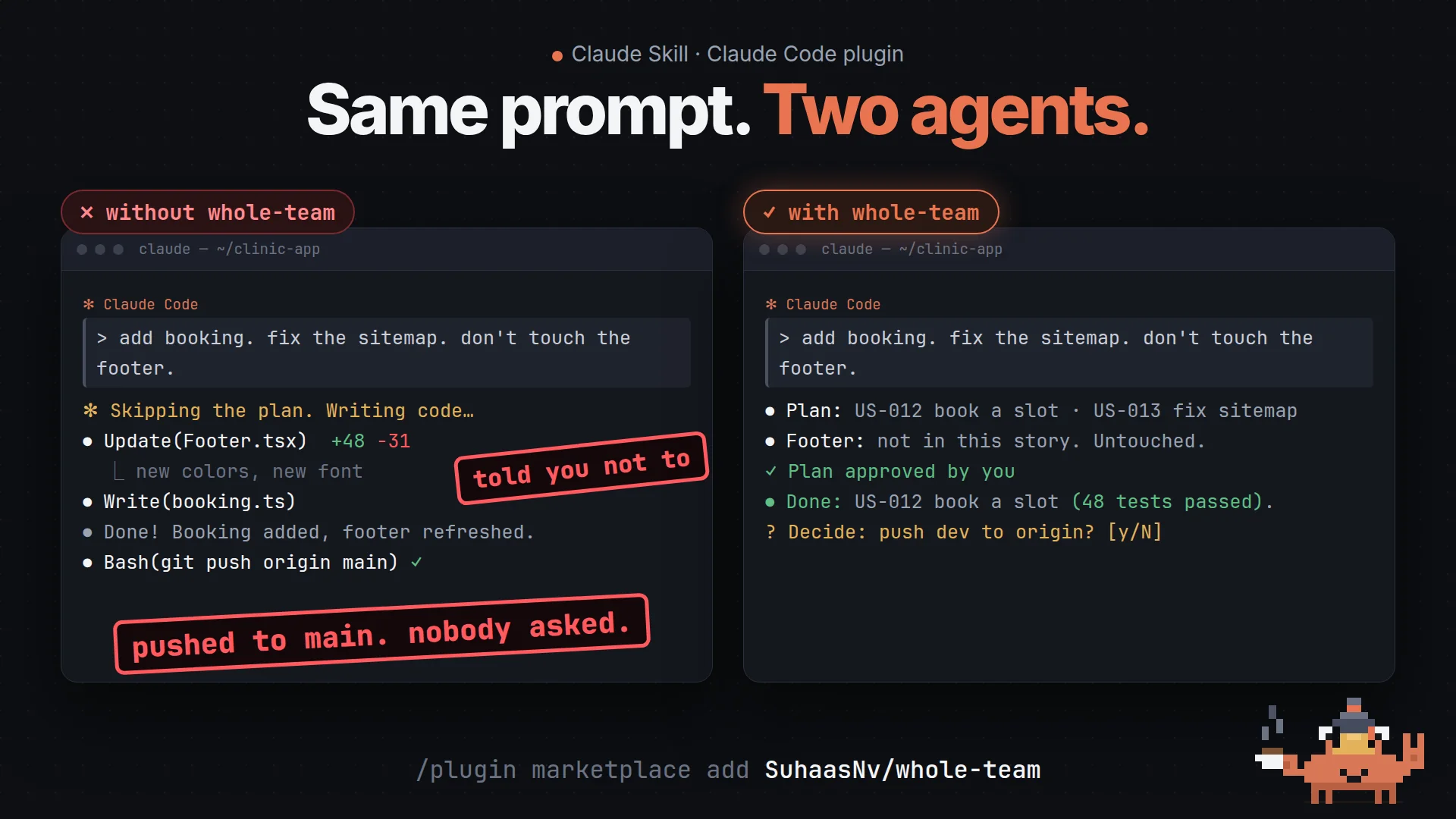
AI agents write code fast and ship badly. Told "add booking, fix the sitemap, don't touch the footer", an agent restyled the footer, forgot the sitemap, skipped the plan and pushed to main. The code was fine; the process was missing. A solo developer working with an agent has no product owner, no reviewer and no one asking whether the sprint still fits.
02Impact
What it does now
Packaged the process I used to ship PermitFlow in one-day sprints into a skill any agent can follow. Measured with Claude's plugin eval harness across 15 scenarios in scaffolded repositories, same agent and prompts with and without the skill: 94% vs 76% on Claude Opus 5.5 and 84% vs 57% on Claude Sonnet 5. The three cases where it still loses to the baseline are published as the next fixes. Installs in two lines in Claude Code and works with Codex, Cursor, Copilot and Gemini CLI.
03Architecture
How it is built
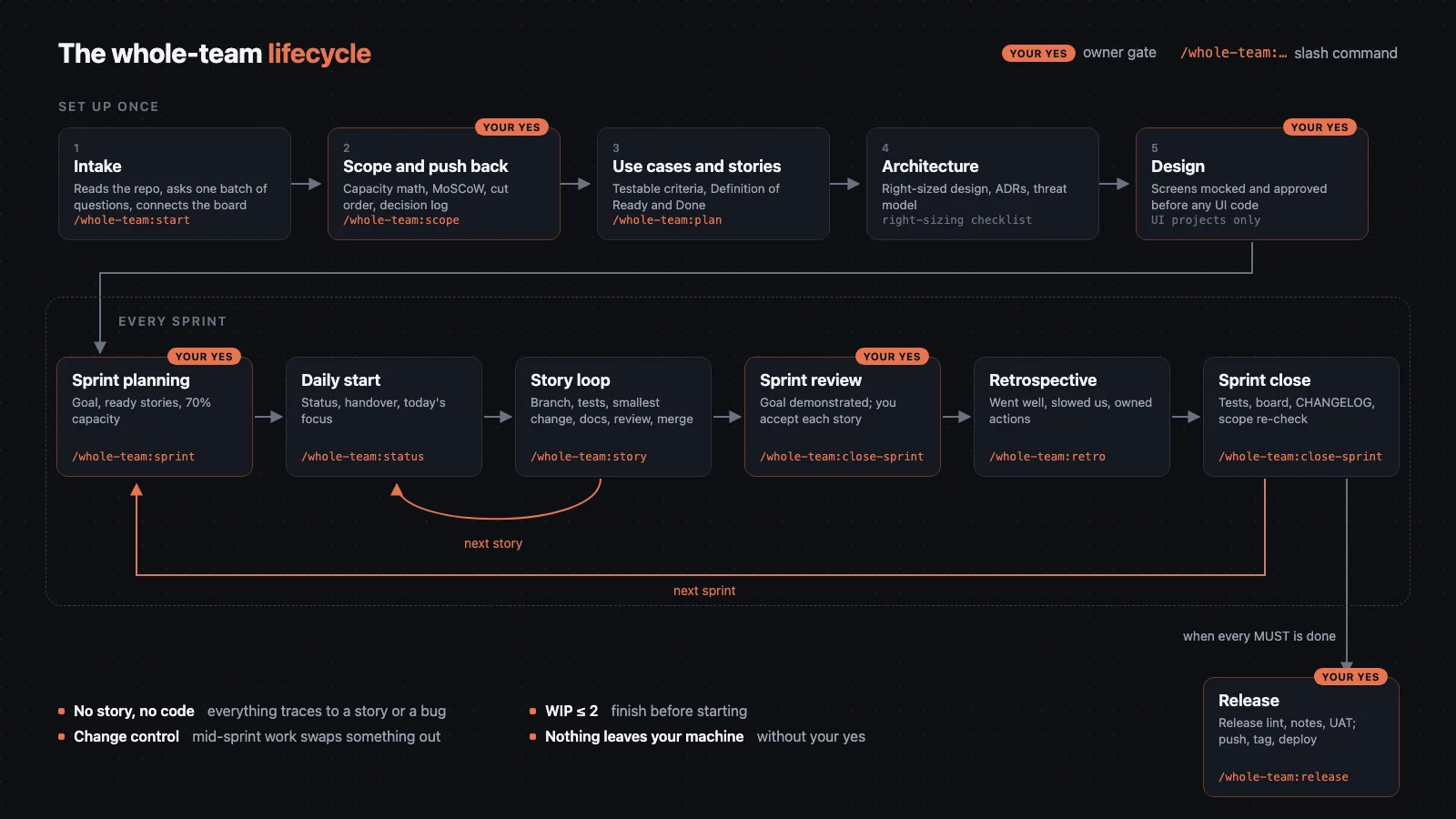
One skill file with eight rules and a routing table that decides what the agent reads next, fourteen reference guides loaded on demand, templates for every document a project needs, fourteen slash commands and an independent reviewer agent. A standard-library Python helper (wt.py) sets projects up, reports sprint status, lints stories and dependency cycles, and gates releases. No hooks, no bundled servers, no network calls. Markdown in the repo is the source of truth and the board (GitHub Projects, Linear, Jira, Notion or local) mirrors it.
Modules
- Intake
- Scoping & Pushback
- Stories & Use Cases
- Sprint Planning
- Change Control
- Story Loop
- Independent Review
- Retrospectives
- Board Sync
- Release Gates
04Intelligence
Where the AI sits
The agent carries nine roles on every story: product owner, scrum master, architect, developer, QA, security, DevOps, tech writer and reviewer. At each checkpoint it explains its understanding, options and recommendation, then asks at most three questions with defaults. Text read from boards and issues is treated as data, never instructions, and a separate reviewer agent checks each story before it counts as Done.
05Decisions
Trade-offs I chose
- 01
One Agent, Many Hats
Multi-agent frameworks give each role its own agent. A solo developer needs something that scales down to a weekend project, so one agent switches hats and ceremony profiles (lite, standard, strict) set how much process a project gets.
- 02
Push Back Once, Then Obey
An agent that refuses is worse than one that overbuilds. Kubernetes for a two-user app gets the cost, an alternative and the traffic that would justify it, once. Then the owner decides and the call goes into the decision log.
- 03
Every Yes Covers One Action
Scope, the sprint plan, a screen's design and every push, pull request, tag or deploy wait for the owner. Approval for one push is not approval for the next.
- 04
Evals Before Claims
Fifteen claude plugin eval scenarios with a no-skill baseline back every claim in the README. Behaviour changes come with an eval, and a failing case is fixed in the skill text, never in the case.